
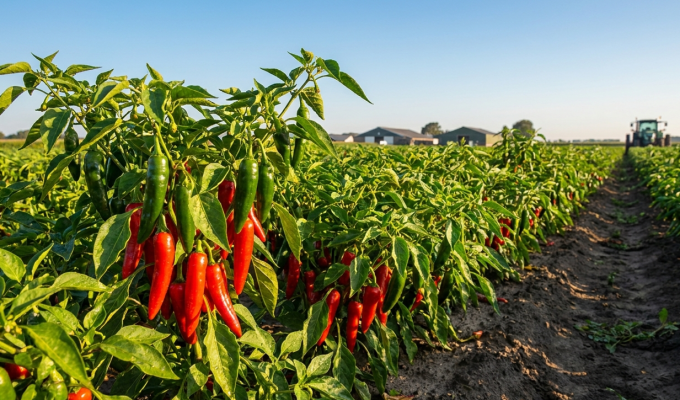
Chili (Capsicum spp.) is a high-value horticultural crop belonging to the Solanaceae family. Grown extensively across tropical and subtropical zones, chili farming offers smallholders exceptional profitability through local fresh sales, drying, and international export markets.

Figure 1: Commercial chili cultivation under optimal ecological management.
1. Botanical Profile & Nutritional Value
Chili plants are closely related to crops such as potato, tomato, black nightshade, and eggplant. The fleshy fruits are harvested for fresh consumption, drying, or processing as a spice and table vegetable.
- Capsaicin & Heat Intensity: Chilies synthesize the pungent chemical compound capsaicin. Pungency levels are measured using the Scoville Scale, ranging from mild sweet peppers to scorching Cayenne varieties.
- Nutritional Composition: Chili fruits represent a potent source of Vitamin A, Vitamin C, and Vitamin B6, alongside essential minerals including Potassium (K), Magnesium (Mg), and Iron (Fe).
2. Commercial Varieties & Ecological Requirements
Primary Commercial Varieties
Selecting the appropriate variety depends directly on targeted market demand, climate, and post-harvest handling plans.

Figure 2: Visual comparison of Long Cayenne and African Bird's Eye (ABE) Chili varieties.
- Long Cayenne: Tall, highly productive plants yielding long, slim pods (10 cm) with very thin, highly pungent flesh. It is a premier choice for export, fresh local markets, and dehydration.
- African Bird's Eye (ABE) Chili: Perennial bushy shrubs producing small, clustered, erect, conical pods (up to 3 cm). Pods transition from green when immature to bright red or purple when mature. Known for extreme pungency.
- Other Commercial Cultivars: Additional grown varieties include Anaheim, Fresno, Jalapeno, Rocket, and Short Bullet.
Optimal Ecological Requirements
For maximum yields and crop vitality, chili production should be established within the following environmental parameters:
| Parameter | Optimal Requirement |
|---|---|
| Altitude | 0 – 1,200 metres above sea level |
| Annual Rainfall | 600 – 1,200 mm annually (supplementary irrigation required below 600 mm) |
| Growing Temperature | 20 – 30 °C |
| Soil Specifications | Well-drained soils of various types with a pH range of 6.0 – 6.5 |
3. Good Agricultural Practices: The G20 Technologies
4. Crop Management & Agronomic Practices
A. Nursery Establishment & Seedling Care
- Seed Rate & Site Selection: Standard seeding requires ∼75 g per acre. Select a well-drained, friable soil site near water, protected from livestock, on land that has not grown Solanaceae crops for at least 3 years.
- Bed Construction: Form nursery beds 1 metre wide. Till to fine tilth and blend 10 – 15 kg of potent manure per square metre. Sow seeds 1.5 cm deep at a spacing of 15 – 20 cm apart, mulch, and irrigate thoroughly.
- Seedling Trays: Recommended for expensive hybrid seeds to achieve uniform germination and growth.
- Nursery Management: Water once daily while checking soil moisture. Upon germination (1 – 3 weeks), remove mulch and construct a 50% temporary shade net or grass shade.
- Hardening Off: During weeks 4 and 5 post-emergence, reduce shade and scale back watering frequency to 3 times per week. Seedlings are ready for field transplanting at 5 – 6 weeks (4 – 6 leaf stage).
B. Transplanting, Spacing & Basal Fertilization
- Transplanting Timing: Transplant at the start of rains when outdoor temperatures are cooler. Irrigate nursery beds prior to lifting seedlings with an intact root soil ball.
- Recommended Field Spacing: Space at 60 cm x 40 cm or 70 cm x 30 cm depending on cultivar vigor, achieving a population density of 16,666 – 19,000 plants per acre.
- Basal Fertilizer & Manure: Incorporate 10 tonnes per acre of well-decomposed manure alongside 100 kg per acre of TSP or DAP (adjusted per soil test results) thoroughly into planting holes before transplanting.
- Water Requirements: Maintain well-distributed moisture. Moisture stress during fruit setting induces severe flower and fruit drop/abortion.
C. Top-Dressing Schedule
Apply first top-dressing when plants reach 15 cm height, followed by a second application 4 weeks later:
| Soil Condition | 1st Top-Dressing (at 15 cm height) | 2nd Top-Dressing (4 weeks later) |
|---|---|---|
| Acidic Soils | 40 kg / acre CAN | 80 kg / acre CAN |
| Alkaline Soils | 50 kg / acre SA (Sulphate of Ammonia) | 80 kg / acre SA (Sulphate of Ammonia) |
Note: High-magnesium foliar feeds are highly beneficial on alkaline soils. Adjust all chemical applications based on soil analysis.
5. Integrated Pest & Disease Management
| Pest / Disease | Key Diagnostic Symptoms | Recommended Control Measures |
|---|---|---|
| False Codling Moth | Nocturnal adults; larvae feed internally inside pepper pods. | IPM field hygiene, destruction of infested fruits, biological controls. |
| Thrips | Extremely small sucking insects causing silver/grey-white spots with black faecal dots and upward leaf curling. | Timely monitoring, targeted systemic insecticides, weed control. |
| Cutworms | Clipped stems at ground level on young transplants. | Handpicking near damaged roots, early field weeding, deep ploughing to expose larvae. |
| Root-knot Nematodes | Microscopic soil worms inducing root galls/swellings, stunting, and wilting. | 3-year crop rotation, intercropping with African Marigold, high soil organic matter, Neem extracts. |
| Damping-Off | Soil-borne fungus killing pre-emergent seeds or causing stem water-soaking/collapse. | Clean nursery site, avoid overwatering, drench soil with Metalaxyl-M + Mancozeb (AMIDIL 68WG®). |
| Powdery Mildew | White powdery fungal growth underneath leaves with upper yellow patches and leaf edge curling. | Destroy crop residues, apply Sulphur sprays (Thiovit Jet®, COSAVET DF®, FLOSUL PLUS®) or organic sulfur dust. |
| Chili Mosaic Virus | Vector-transmitted (aphids); leaves show light/dark green mosaic patches, ring spots, and plant stunting. | Control aphid vectors, use certified disease-free seeds, rogue out and burn infected plants immediately. |
| Fusarium Wilt | Soil fungus spread by irrigation; causes drooping, yellowing lower leaves, and vascular stem discoloration. | 3-year crop rotation away from Solanaceae, improve field drainage, plant resistant varieties. |
| Phytophthora Blight | Severe during heavy rains; dark brown stem lesions, sudden leaf wilting, white interior fruit fungus. | Use certified seed, cultivate on raised beds, rotate every 3–4 years, apply Copper Oxychloride (COBOX 50 WP®, AMICOP 50WP®). |
6. Harvesting, Drying & Post-Harvest Handling
Harvesting Indices & Yields
- Maturity Period: First picking begins 2.5 – 3 months post-transplanting and continues harvesting for 4 – 6 months.
- Harvesting Practice: Handpick mature pods based on target market color specifications. Immediately move picked pods to shade to prevent moisture loss and shriveling. Handle with extreme care to prevent physical bruising.
- Expected Field Yields: Standard yields range between 4,000 – 6,000 kg per acre.
Cold Storage & Pre-Cooling
- Pre-cool harvested chilies to 7 – 10 °C.
- Chilies can be stored for up to 3 weeks at 7 – 10 °C under 90 – 95% Relative Humidity (RH).
Harvest chilies when red for drying. Dry on raised racks spread over well-aerated polysacks for 3 – 4 sunny days or utilize enclosed solar cabinet dryers for optimal hygiene.
- Target Storage Moisture: Maintain final pod moisture between 10 – 15% to eliminate mold risk.
- Over-Drying Danger: Moisture levels dropping below 10% render pods extremely brittle, causing shattering during handling. This releases irritating capsaicin dust that affects workers' skin and respiratory system.
- Store dried pods in clean facilities under 60 – 70% Relative Humidity.
