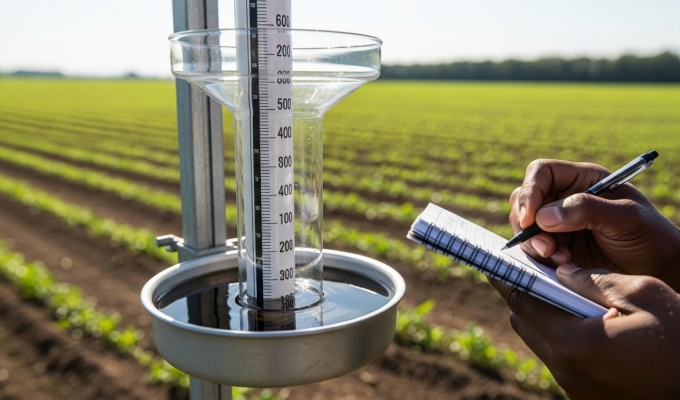
In modern agriculture, where every drop of water and every dollar counts, the rain gauge remains one of the most valuable, yet often overlooked, tools on the farm. Far from being a simple bucket, this device is a critical component of a data-driven water management strategy, allowing farmers to transition from guesswork to high-precision irrigation scheduling
. For operations in regions with variable or unpredictable rainfall, the rain gauge is the unsung hero that ensures water is used efficiently, maximizing yield while minimizing waste.
The Data-Driven Advantage: Why Measurement Matters
The primary role of the rain gauge is to provide an accurate, localized measurement of precipitation. This data is essential for two key reasons:
1.Preventing Over-Irrigation: A rain gauge allows you to precisely quantify the amount of natural rainfall your fields have received. This prevents the common mistake of running irrigation systems unnecessarily, which saves water, reduces energy costs, and protects crops from waterlogging and disease.
2.Informing Irrigation Scheduling: By knowing exactly how much rain has fallen, you can accurately calculate the remaining water deficit in the soil. This data is then used to adjust your irrigation schedule, ensuring that the total water applied (rain + irrigation) meets the specific needs of your crop at its current growth stage
.
As a low-cost tool, the rain gauge provides a significant return on investment by helping producers take full advantage of rainfall, thereby reducing the reliance on expensive irrigation water
.
Choosing and Placing Your Gauge
While the principle is simple, accuracy depends on the right equipment and proper placement.
Types of Rain Gauges for Agriculture
|
Type |
Description |
Pros |
Cons |
|
Standard (Manual) Gauge |
A simple, clear cylinder with a funnel, often with a large capacity. |
Highly accurate, low cost, no power required. |
Requires manual reading and recording. |
|
Tipping Bucket Gauge |
An electronic device where a small bucket tips after a set amount of rain (e.g., 0.2 mm), sending a pulse to a data logger. |
Automated, continuous data logging, ideal for remote monitoring. |
Can be less accurate in very heavy rain or light drizzle; higher initial cost. |
|
Weighing Gauge |
Measures the weight of the collected water, providing highly accurate data on rainfall intensity and duration. |
Highest accuracy, measures all forms of precipitation. |
Most expensive and complex. |
For most small to medium-sized operations, a high-quality standard manual gauge with a wide opening (at least 4 inches in diameter) is a reliable and cost-effective choice 5
.
Best Practices for Placement
The location of your rain gauge is critical for obtaining a representative reading:
- Open Area: The gauge must be placed in an open area, away from tall obstructions like trees, buildings, or large equipment, which can block rain or cause wind turbulence that affects collection.
- Height: The gauge should be mounted securely at a height that is easy to read but low enough to minimize wind effects, typically about one meter above the ground.
- Level: Use a spirit level to ensure the gauge is perfectly horizontal. A tilted gauge will collect rain unevenly, leading to inaccurate readings
.
Integrating the Data into Your Farm Plan
The data from your rain gauge should be a daily input into your farm management decisions.
1.Daily Recording: Record the rainfall amount immediately after a rain event. If you are using a manual gauge, record the reading and then empty the gauge to prepare for the next event.
2.Long-Term Trend Analysis: Keep a log of your rainfall data. Tracking long-term trends helps in making strategic decisions on crop selection, planting dates, and overall water budget planning for future seasons
.
3.Irrigation Adjustment: If your crop requires 25 mm of water per week and your rain gauge shows 10 mm of rain has fallen, you know you only need to supplement with 15 mm of irrigation, rather than the full 25 mm. This simple calculation is the essence of water-saving precision.
