By Michelle Chifamba
As global aquaculture and fisheries production continues to surge, Zimbabwe is turning to its vast and underutilized water resources as a frontier for economic growth. Driven by rising demand for fish both locally and internationally, policymakers and investors are casting their nets wider, hoping the sector can unlock new opportunities in Zimbabwe’s evolving blue economy and agricultural landscape.
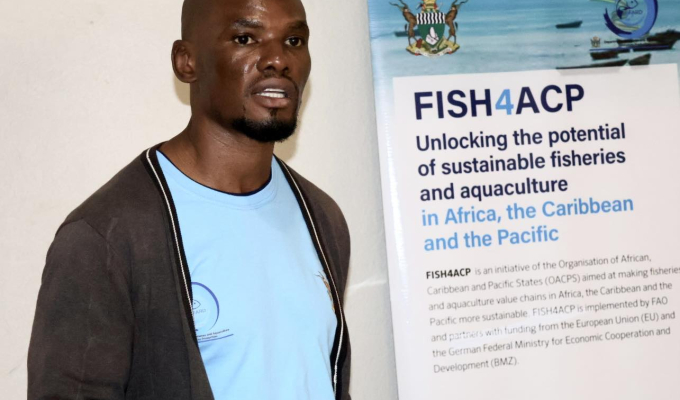
The Ministry of Lands, Agriculture, Fisheries, Water and Rural Development (MLAFWRD), in partnership with the Food and Agriculture Organization (FAO), recently convened an Aquaculture Frame Survey Validation Workshop in Harare. Held under the FISH4ACP project—an initiative funded by the European Union (EU) and the German Federal Ministry for Economic Cooperation and Development (BMZ)—the workshop sought to strengthen the productivity and sustainability of Zimbabwe’s fisheries and aquaculture sector.
Validating the Potential of Small-Scale Farmers
The workshop reviewed and validated findings from a nationwide survey that gathered data from small-scale fish farmers across several provinces. The study focused heavily on Mashonaland West, Mashonaland East, and Mashonaland Central, where aquaculture activities are steadily expanding. This feasibility study analyzed the potential of aquaculture to offer an economic lifeline in Zimbabwe’s drive for sustainable development.
The review cited that Zimbabwe’s aquaculture sector faces sizeable production gaps, with economic demand for fish significantly exceeding domestic supply. While isolated success stories exist, the survey recorded numerous challenges affecting production capacity, including demographic factors, environmental constraints, and limited access to water sources.
Demographic Disparities and the Gender Gap
A critical finding of the survey is that the fish farming sector is highly male-dominated and primarily family-owned. Women and youth are significantly underrepresented in ownership roles, which impacts the sector's overall production capacity and economic contribution.
According to results presented by Lorraine Salimu from the MLAFWRD, "Aquaculture is a growing sector that needs to be tapped into for economic development, although there are a few challenges affecting productivity. Significant aquafarms depend on unpaid permanent workers and family labor, with women playing a major role in offering this unpaid labor rather than owning the enterprises."
The data revealed stark disparities:
-
Male Dominance: In Mashonaland Central, male ownership rates range from 71.7% in Mbire to 94.1% in Bindura. In Mashonaland West, ownership is 100% male in Makonde Urban and exceeds 70% in districts like Hurungwe, Zvimba, and Sanyati.
-
Family Ownership: This remains the primary arrangement, reaching 100% in districts like Mudzi and Muzarabani.
-
Youth Gap: Participants aged 35 and below are entirely absent in districts such as Muzarabani, Shamva, and Guruve.
-
Education: Interestingly, the workforce is relatively well-educated, with Tertiary and O-Level completions making up the majority of operators—peaking at 72.2% tertiary completion in Makonde Rural.
"There is an urgent need to support women’s participation in fish farming as owners and entrepreneurs, not just laborers, to bridge the gender gap and ensure equal access to resources," Salimu noted.
Production Gaps and Market Barriers
The aquaculture sector in Africa is often hampered by a reliance on tilapia farming, which depends on fingerling production that is largely imported. In Zimbabwe, the demand for fingerlings alone is estimated at over 10 million per production season.
Despite the high demand, farmers remain locked in low-volume, informal trade. The survey found that:
-
Informal Markets: Most farmers rely on direct sales to neighbors and community members. In Mashonaland West, Hurungwe district has the highest concentration of neighbor-based sales.
-
Limited Formal Integration: Sales to supermarkets and formal retail channels are negligible. Bindura reported the highest formal retail engagement, yet even there, it stands at only 24%.
-
Lack of Processing: Post-harvest value addition is minimal. Most fish are sold fresh or undergo basic gutting, with very little drying, salting, or smoking to extend shelf life.
"Farmers are missing opportunities for growth and stability offered by formal retail markets," the report states. "The lack of consistent market access in several areas places farmers at risk of business failure, highlighting an urgent need for market linkage interventions."
Overcoming Structural Challenges
The review noted that the sector is riddled with challenges that must be addressed to ensure sustainability.
|
Province |
Primary Challenges Identified |
|---|---|
|
Mashonaland West |
Capital (43%), Lack of technical knowledge (37%), Feed supply (36%) |
|
Mashonaland East |
Land/Space (48%), Lack of knowledge (45%), Water supply (38%) |
|
Mashonaland Central |
Feed supply (52%), Capital (44%), Water supply (41%) |
To unlock the sector's potential, the MLAFWRD emphasized the need for diversification into a wider variety of fish species and more rigorous marketing to tap into regional markets.
A Path Toward Economic Growth
The findings from the feasibility study conducted by the Ministry and FISH4ACP reveal that aquaculture has the potential to become a key economic driver for rural farmers and the nation at large. By tapping into domestic and foreign markets, Zimbabwe can achieve greater economic growth and sustainability.
However this potential can only be realized through targeted interventions: supporting youth and women, improving access to formal markets, and providing the technical and financial capital necessary to bridge the current production gaps. With the right support, Zimbabwe’s "blue revolution" could be just over the horizon.
_large.jpg)